

AI writes your content. Your audience knows.
A 5-step system for using AI without losing your voice


Last month a client showed me her Claude project. Four custom skills. A content calendar automated to the hour. Prompt chains for hooks, bodies, CTAs, sign-offs. She had watched every YouTube tutorial, read the documentation, built the whole thing properly.
Her last 10 posts averaged 180 impressions.
I scrolled through them on her screen while she sat there, quiet. Each post was clean. Grammatically tight. Well structured. Completely interchangeable. If you swapped her name for someone else’s, nothing would break.
She looked at me and said, “I don’t understand. I did everything right.”
She followed every step. That was the problem.
I hear some version of this every week. Someone smart, with real expertise, builds a solid AI system, feeds it a topic, gets output, publishes. The output reads fine. It reads like everyone else’s content.
Because the audience does not care about your setup. They care whether there is a human behind the words. AI, left alone, removes the human faster than most people realize.
AI is a big piece of how I work. I’ve built voice profiles, anti-AI filters, content workflows, and Claude projects my clients use every day. A serious chunk of my business comes from helping people use these tools well.
But I still never let AI write my first draft.
Your first draft is ugly (and that’s the point)
The first draft is where the personality lives. The weird phrasing. The opinion you are not sure you should share. The sentence that makes your stomach drop a bit. The detail nobody else would have picked.
That stuff comes from you sitting with a blank page and writing what you think. Not from a model predicting what sounds good.
AI has no access to the real wiring. It does not know why you phrase things the way you do. It does not know which failure changed your entire view on pricing, and it has zero interest in your humor. It mirrors language. That is a different thing from knowing you, and the difference shows up in every post.
I spent ten years hiding my personality in corporate meetings, softening opinions and removing anything that made people uncomfortable.
Then I stopped. The right people showed up faster than they ever had before.
That change had nothing to do with better prompts.
It had everything to do with saying what I thought, out loud, in rooms where it cost me something.
You have to earn the right to automate
I wrote about this before in The Quiet Death of Knowing How. The short version is simple. AI made production faster. The bottleneck was never production. It was thinking.
And yet I keep watching creators skip straight to the tools.
They build prompt chains before they’ve written 50 posts by hand. They automate funnels they have never run manually and build voice files before they know what their voice sounds like.
The output looks clean and structured. But it is hollow as f*ck.
Because they automated a skill they never built. Sorry guys, you can’t shortcut your way to a voice.
You build one by writing badly, often, for months. By publishing something you thought was sharp and watching it get 40 impressions, then staying with a half-formed idea long enough to figure out what you actually believe.
Every craft works like this.
A chef does not start with a Thermomix. You learn the feel of the material first, and only then does the machine become useful.
Once you’ve done that work, AI becomes a multiplier. Before that, it becomes a crutch that hides the gap between what you know and what you think you know.
If you’re early, do the reps first. Write manually and post without Claude. Build the muscle, then bring in the tools.
But 90% of the people reading this won’t do that. They want the output, even if it’s generic. They don’t want to learn the craft. And that is exactly why the 10% who do the work stand out so fast.
One raw paragraph beats 10 curated posts
The client I mentioned earlier? I asked her to do something she hated.
Close Claude. Open a blank doc. Write one paragraph about something that happened that week that pissed her off.
She stared at the screen for maybe 90 seconds.
Then she wrote about a call with a prospect who told her, “We already have someone who does what you do, but cheaper.” She wrote about hanging up, sitting in her car for 10 minutes, and Googling the cheaper person. She wrote about how that person’s LinkedIn was full of AI-generated carousels, stock photos, and “5 tips for better leadership” energy. She wrote about wanting to scream and quit on the same afternoon.
That paragraph had more personality than her last 10 posts combined.
So I pasted it into Claude with her voice files loaded and asked for five angles she could turn into a LinkedIn post. Claude came back with angles rooted in her experience, her frustration, her specific read on the market.
One of them was: “The person undercutting you on price is outposting you too. Here’s why that doesn’t matter.”
That worked because it came from something that happened to her, on a Tuesday, in her car. Not from a prompt asking Claude to “write a post about differentiation.”
That is where AI earns its place. It helps you find connections between lived material and positioning you would miss on your own.
But the moment you ask it to manufacture the lived material too, the whole thing collapses.
The order of operations is backward
This is the mistake I see most, and it is everywhere.
People open Claude first. They type a topic, get output, tweak two words, and publish. Then they wonder why it sounds like a polite stranger who memorized their résumé.
I do it backward.
Here’s what that looks like on a real Saturday morning.
Step 1: Mine your week (10 minutes, no Claude)
Open a blank doc. Set a timer for 10 minutes. Write down 2 to 4 things that happened this week.
A conversation that stuck with you. A moment that annoyed you. Something a client said that is still rattling around in your head. Something you noticed that other people seemed to miss.
No structure, no cleanup. Write it the way you would text a friend:
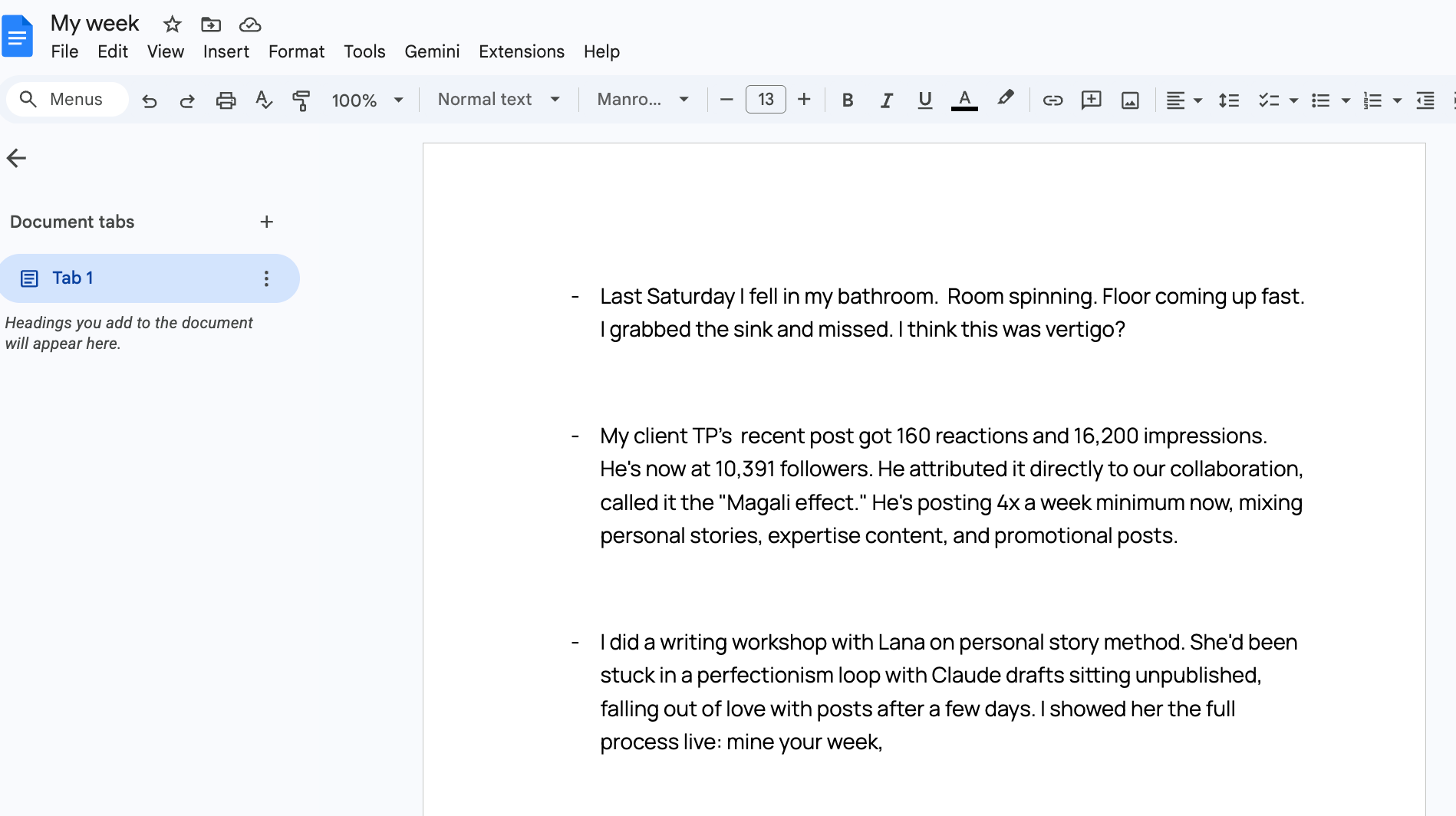
That is enough raw material with your fingerprints on it.
Step 2: Ask Claude for angles (5 minutes)
Paste your raw notes into Claude along with your positioning doc. That doc should explain who you help, what you believe, what you sell, and what makes you different.
Then use this prompt:
Based on these notes and my positioning, give me 5 to 7 angles I could turn into a LinkedIn post.

Each angle should connect a specific moment from my notes to a broader point about my work.
Claude is good at this. It spots connections between your lived material and your positioning that you miss when you are still too close to the experience.
Pick the angle that gives you a gut reaction. That is usually the right one.
Don’t have a positioning doc yet? Build one first. Without it, Claude has nothing meaningful to work with.
Use this prompt:
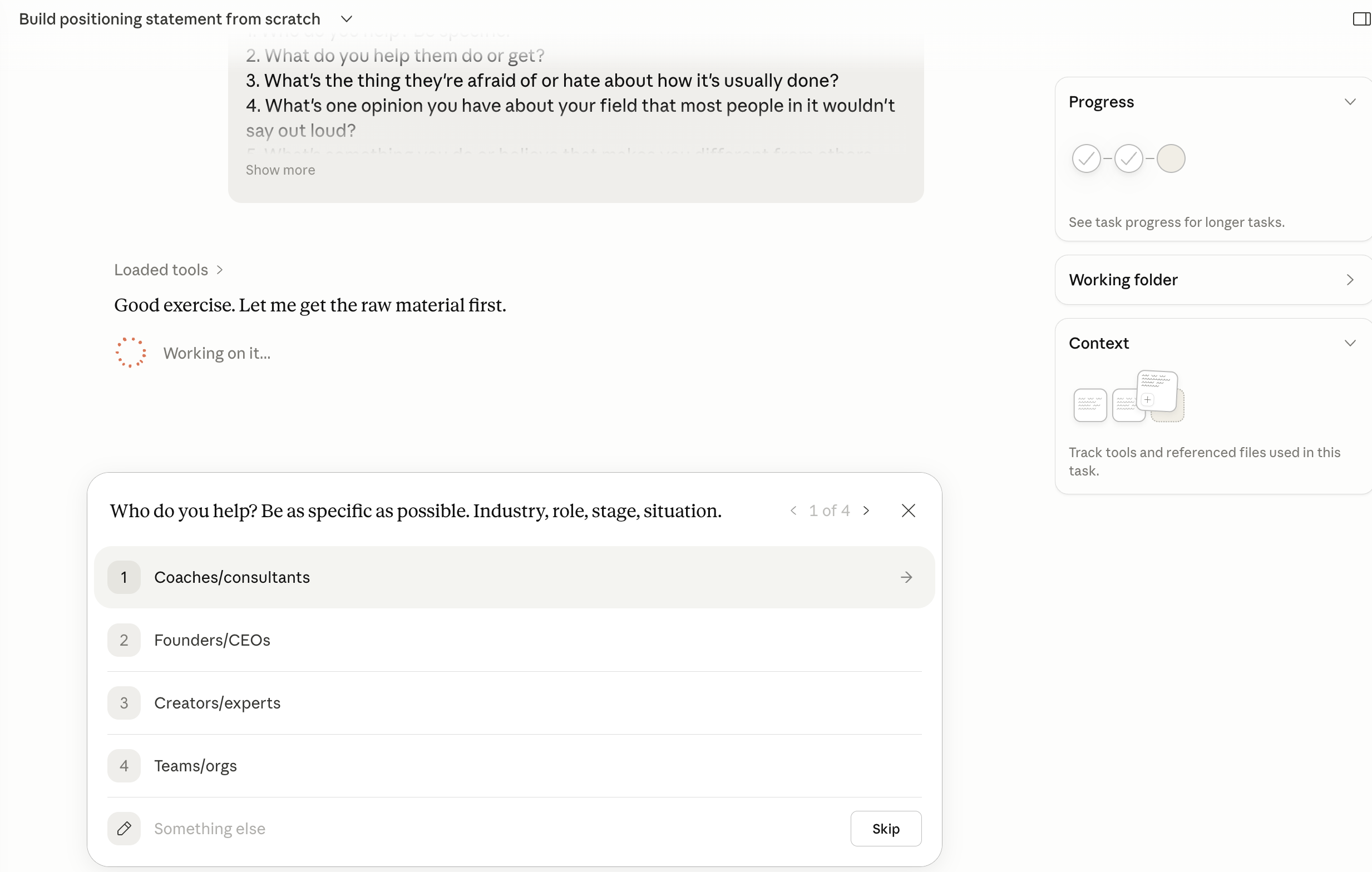
AskUserQuestion: "Let's build your positioning statement. Answer these questions, one by one or all at once, whatever feels natural.

1. Who do you help? Be specific.
2. What do you help them do or get?
3. What's the thing they're afraid of or hate about how it's usually done?
4. What's one opinion you have about your field that most people in it wouldn't say out loud?
5. What's something you do or believe that makes you different from others who offer something similar?"

Take the answers above and write a personality-first positioning statement in this structure:
"I help [specific who] [do/get what] without [fear or frustration]. I believe [contrarian or specific opinion]. What makes me different is [specific differentiator]."

Then write 2 to 3 alternative versions that play with tone: one more direct, one with more edge, one that leads with the belief instead of the who.

Flag any answer that feels vague or generic and tell me what a more specific version could look like.
Answer every question as specifically as you can:
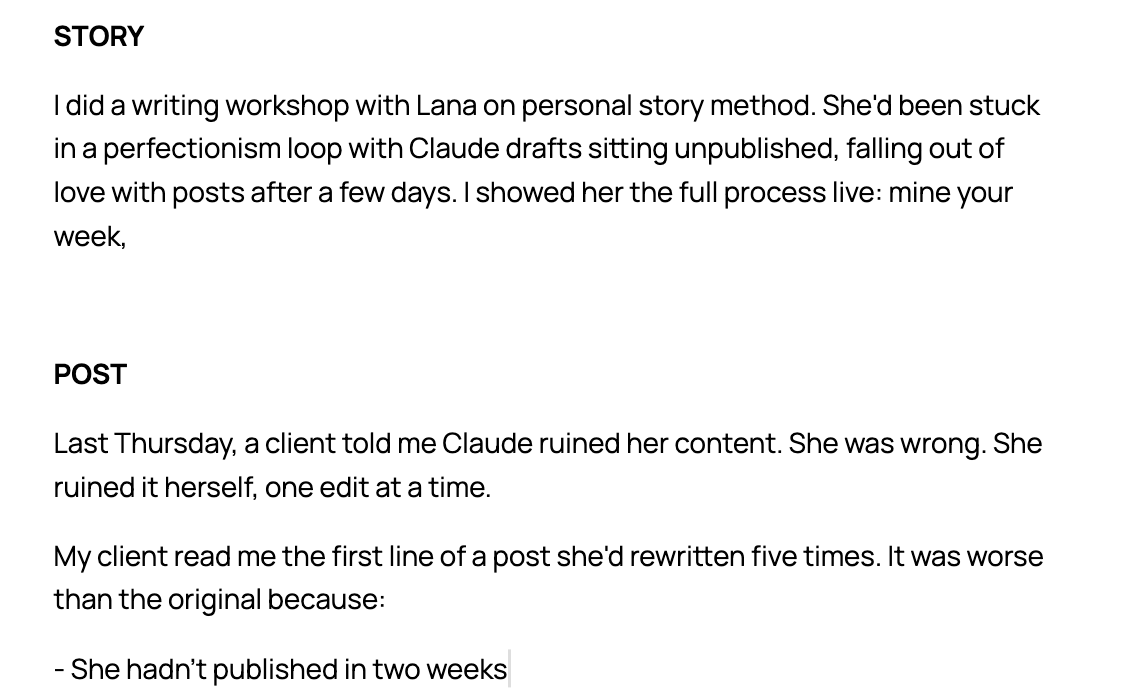
Step 3: Write the draft yourself (15 to 20 minutes, no Claude)
This is the step most people try to skip. Do not skip it.
Start with the hook. One line that drops the reader into a scene. Who was there. Where it happened. What was at stake.
Then write like you are explaining to a smart friend what happened and why it matters. Set the scene, give context, make the point, close it.
Do not worry about formatting yet. Forget about length. Get the thinking down first.
Hand the whole thing back to Claude too early and the voice disappears. Your observations, your reactions, your sentence rhythm, your specific details.
That is the one thing AI cannot invent, and no prompt on earth will fix that gap once you’ve outsourced it.
Step 4: Let it ripen (2 to 4 hours minimum)
Walk away and do something else. Let your brain stop performing.
When you come back, the lines that felt sharp in the moment often feel forced. You will spot the sentence trying too hard. The point that does not land. Cut those without mercy.
You do not need distance because you are a bad writer. You need it because judgment gets better when ego calms down.
Step 5: Let Claude edit, not generate (5 minutes)
Once the draft exists, then Claude can help. This prompt works like a charm:
I want you to edit this LinkedIn post for skimmability and clear story flow.

Rules:
- Tighten language. Cut filler words, weak openers, and overwritten phrases.
- Remove redundancy. If the same idea appears twice, keep the sharper version.
- Improve formatting for LinkedIn skimmability: max 2 sentences per paragraph, single line breaks between them, no walls of text.
- Do not change my voice, sentence rhythm, or opinions.
- Do not add transitions, connective phrases, or sentences I didn't write.
- Do not replace specific names, dates, numbers, or examples with generic alternatives.
- Do not reorder sections unless the logic is broken. If you think it is, flag it.
- If a sentence feels unclear or awkward but you're unsure how to fix it without changing my voice, mark it [FLAG: reason].

Return:
1. The edited post
2. A bullet list of what you changed and why (be specific, not vague like "improved clarity")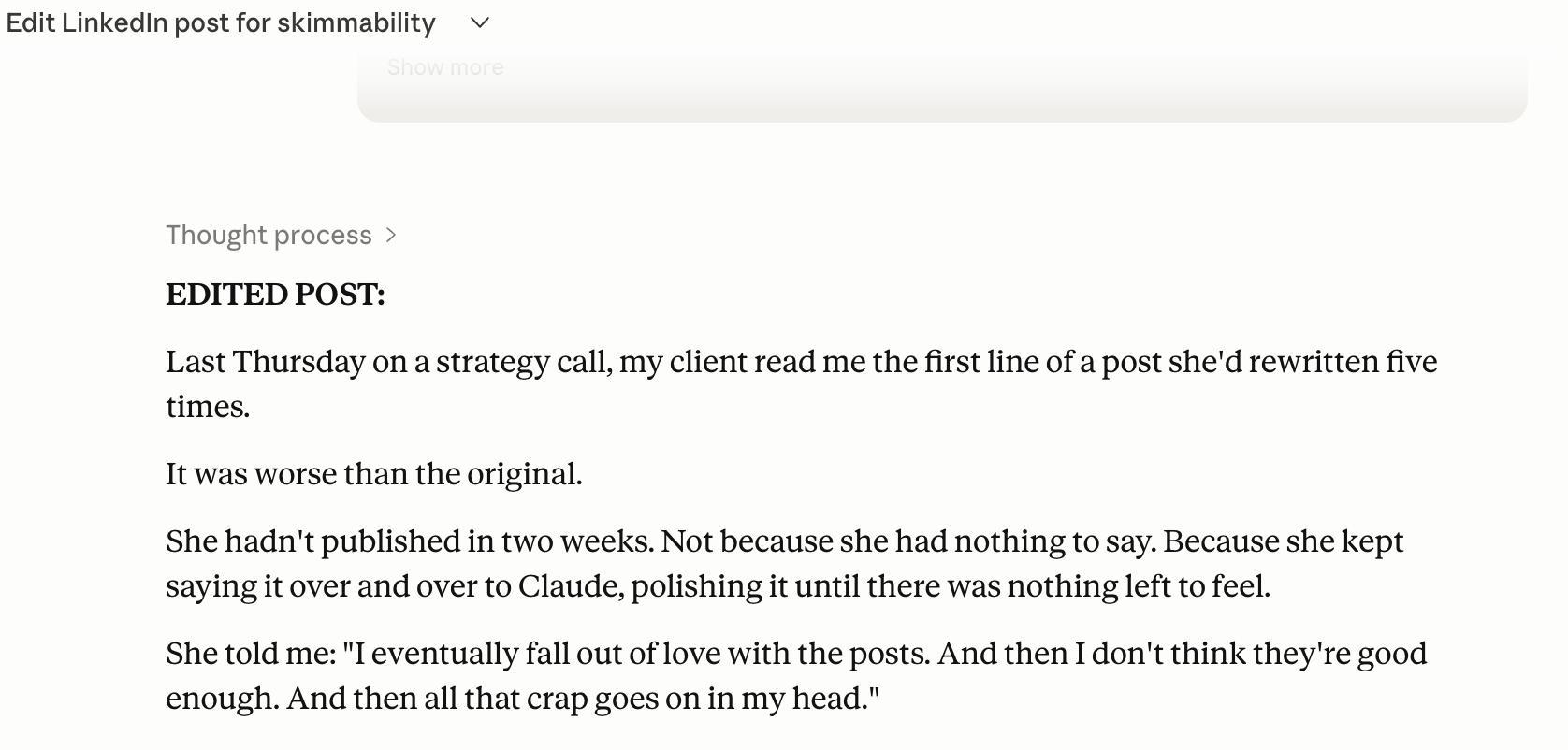
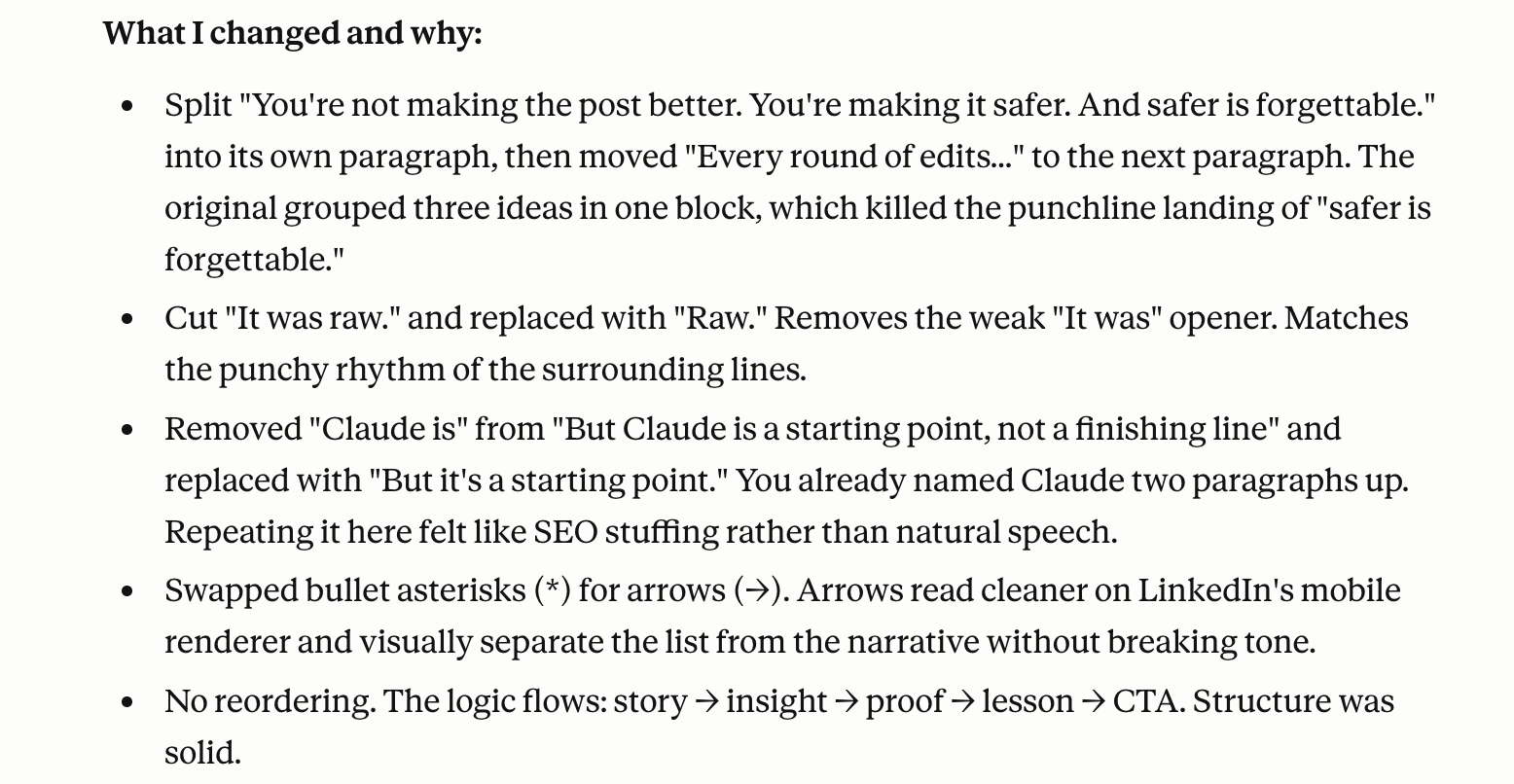
Claude edits what I write. I write what I think. That line has never moved, and it never will. But I also never hit publish on what Claude hands back without reworking it myself. I add bullets, reorder things, and make sure the list reads evenly.
Because I know how writing works, and Claude does not.
The filter that changed everything
There is one more layer, and it changed my content more than anything else I built.
I keep an anti-AI writing filter. It lists the words, expression patterns, and structural tells that make a reader’s brain register “a machine wrote this” before they even finish the first paragraph.
I run it as a final pass on everything I publish. My clients do too.
The full skill lives inside my community. For a single post, the version below works well.
Clean up the text below. Apply every rule silently.

[PASTE TEXT HERE]

---

VOICE RULES

Write directly, specifically, and naturally.
Short paragraphs. Vary rhythm. Fragments allowed when natural.
Use contractions. Use I and you. Active voice.
Be specific: numbers, names, details, tradeoffs, real examples.
If the point is made, stop.

---

BANNED WORDS

Delete or replace: delve, realm, harness, unlock, tapestry, paradigm, cutting-edge, revolutionize, intricate, showcasing, crucial, pivotal, surpass, meticulously, vibrant, unparalleled, underscore, leverage, synergy, innovative, game-changer, testament, commendable, highlight, emphasize, boast, groundbreaking, align, foster, enhance, holistic, garner, pioneering, trailblazing, unleash, transformative, redefine, seamless, optimize, scalable, robust, empower, streamline, elevate, adaptive, effortless, data-driven, proactive, visionary, disruptive, reimagine, unprecedented, intuitive, synergize, democratize, accelerate, dynamic, immersive, supercharge, enduring, captivate, the ones, the part

---

BANNED VERB CONSTRUCTIONS

Replace with plain verbs (is, has, uses, gives, shows, causes, changes):
serves as, stands as, marks a, represents a, boasts a, features a, offers a, plays a role in, helps to, aims to, seeks to

---

BANNED OPENINGS AND PHRASES

Delete: In today's / It is important to note / It is worth noting / In order to / Let's dive in / Let's explore / Let's unpack / At the end of the day / Moving forward / To put this in perspective / What makes this particularly interesting / The implications here are / It goes without saying / Nobody is talking about / Most people don't realize / In this article I will / Despite its strengths / Challenges and future prospects / What this means is / The reality is

---

BANNED TRANSITIONS

Replace with a real transition or nothing: Furthermore / Additionally / Moreover / That said / That being said / With that in mind / It is also worth mentioning / On top of that

---

BANNED ENGAGEMENT BAIT

Delete: Let that sink in / Read that again / Full stop / This changes everything / Are you paying attention / You are not ready for this

---

NEGATIVE PARALLELISM BAN

Delete any construction that rejects one idea and replaces it with another.

Banned patterns: This isn't X. This is Y. / Not X. Y. / Forget X. Focus on Y. / Less X, more Y. / You don't need X. You need Y. / The problem is not X. It is Y. / It was never about X. It was always about Y.

Also banned when softened: While X may seem / Although X appears / Sure, X / Most people think X / At first glance / On the surface / Conventional wisdom says X.

Fix: delete the rejected frame. State the positive claim directly.

---

RULE OF THREE

If any claim is structured as exactly 3 parallel items, cut to 2 or expand to 4.

---

FALSE INTIMACY

Delete: Here is the truth / I will be honest with you / Can I be real / Between us / I am going to say something most people won't.

---

ANALOGY AND METAPHOR

No analogies unless the subject is technical or abstract and the analogy is shorter and more precise than the literal explanation.

Delete metaphor verbs used for abstract work: sanded down, bolted on, stitched together, layered, carved out, baked in, sparked, anchored, distilled, unpacked, crystallized, sharpened, surfaced, amplified, sculpted, cemented, bridged.

Use literal verbs: cut, added, removed, changed, joined, caused, showed, explained, fixed, named, listed, chose, rejected.

---

LINKEDIN-SPECIFIC PATTERNS

Delete hook shapes: I [did thing]. Here's what I learned / Unpopular opinion / Hot take / This might upset some people / Nobody talks about this / Steal this / Save this post / I used to think X. I was wrong / [Year] taught me [lesson].

Delete closing moves: What do you think / Drop your thoughts below / Tag someone who needs this / Which one resonates / Follow me for more / A moral spelled out in the final line.

Delete fake vulnerability: vague struggle without a specific date, number, name, or consequence.

---

FINAL CHECK

1. Cut the first sentence if it is throat-clearing
2. Replace vague claims with specific ones
3. Remove fake importance (pivotal, key turning point, major shift)
4. Remove repeated sentence shapes
5. Remove assistant chatter
6. Cut the ending if it only repeats the point
7. Ask: does this sound useful, or overworked?

---

OUTPUT

Return the cleaned version.
Then: one line per change, what you changed and why. No elaboration.
Once you start spotting these patterns, your own feed looks different fast. You see the fingerprints everywhere. And you understand why audiences scroll past content that looks clean but feels dead.
Your value is in the deviation
AI produces the average of its training data. That is useful for speed. It is terrible for distinction. And distinction is the only thing that makes a personal brand worth following.
Your value lives in how far you deviate from that average.
That deviation cannot be prompted into existence. It has to already exist in what you feed the model, which means it has to already exist in you. In the texture of your week, in the call that made you angry, in the client sentence you cannot stop thinking about, in the opinion you are still scared to publish.
AI makes me faster. The voice is still mine. And that order will never change.
Write the first draft yourself and let it be rough. AI cleans it up after. The rough is where the voice is.
If you want to stop sounding like everyone else and start sounding like you, Content to Gigs is where that happens. Personality-first positioning, voice files, anti-AI filter, the full system. We build it together.
That's exactly what I posted a couple of days regarding Claude Ai. A machine is not knowing your voice, angle and what you want to transmit.
Better to be human than automated.